
It took a long time for me to get my degree. I was in the oddest situation when it came to finishing it. I had written academical papers and gotten a scholarship, doing academical investigation and yet at the time I did not have my degree. It was a situation that sterned not from my own academical failings, for most of my lecturers agreed I was genuinely interested and good at studying the topic, but rather my lack of stability in life. From being unhoused, moving between domestic violence shelters and not having internet during covid, to literally moving countries when my classes were presential in Lisbon. When I shone, I shone really bright, with lecturers advising me to apply for a masters and being interviewed in studies for Standford. Some of my work in Talking-Translation was referenced by sites such as Eurogamer, and I have had several academic papers in consideration for different journals. In a way the degree was a formality, as even my lecturers agreed that I was doing Masters level of work and research. When it came to translation studies, theory or history I was not only good. I was top of my class and read books on it for fun.
But I’m not mentioning my degree to stroke my ego, or to shut down my imposter syndrome that insists on coming. While having a diploma that ISO certifies me and a healthy dose of materials from my classes so I can tap back into research or curiosity is good the reason I bring my university degree is because the topic of today’s practical examples starts with an anecdote from when I was studying. This, I believe will set the mood and get you ready for the practical example today. So what is that story? Where do we start? Well, let me first set up the scene…
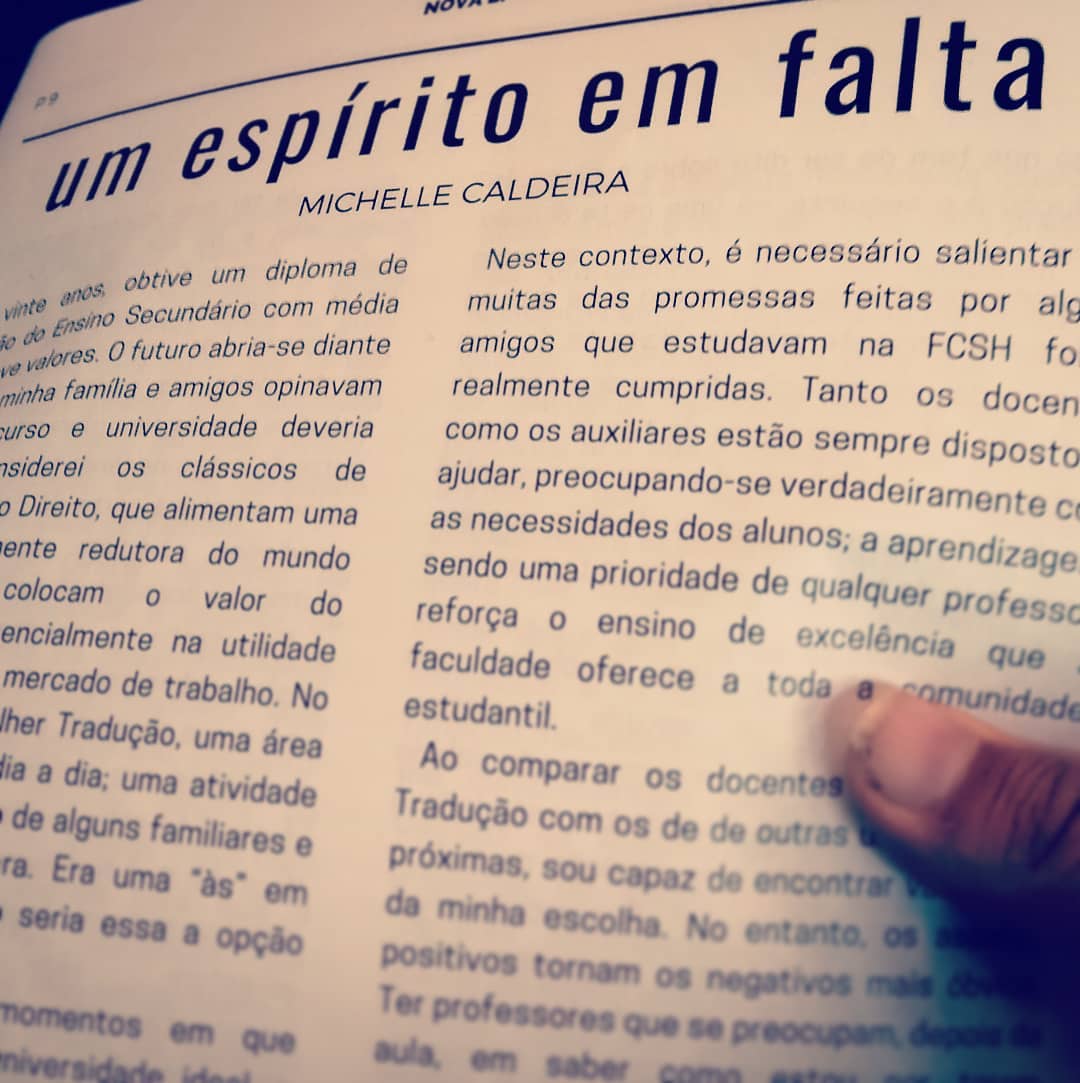
Photo of an article ub the NOVA FCSH school Paper entitled “Um espirito em falta” by Michelle Caldeira. The author holds the physically printed school paper pointing at her article.
Literary Translation – As a Class
The reputation the teacher for Literary Translation had in our university was that she was tough but fair. Aided perhaps by misogyny the teacher was seen as cold and dismissive. I had been having the lessons on practicing literary translation alongside lessons on subtitling and business translation that year. The subtitling and business translation teacher was the total opposite of the literary translation teacher. Warm, inviting, liked to make jokes and reference media. Much like I do in this blog, she used down to earth examples and seemed familiar with internet culture. She introduced us to subtitling by talking about the fansub culture, she liked Sailor Moon and she had us translate store pages for videogames when we weren’t doing contracts. She was warm, inviting and sometimes she felt closer in attitude and approach to a student than a teacher. Not to say that she wasn’t qualified. She had an impressive resume and her lessons on legal translation have stuck with me. But she was the encouraging kind, aware of different gender identities, fanfic and K-Pop.
Our Literary Translation Teacher was far different. Some had called her haughty, but the truth was that she had standards and if someone put in the work she quickly warmed up to you. She had insights into the industry and very clearly defined opinions and if you did some mistake or an inexplicable translation she wasn’t afraid to tell you. A scholar on Herman Melville she also taught 19th century american literature, North american culture at the university and she had gained a nickname. IOM, for Isabel Oliveira Martins. Whenever she was mentioned it was always as “IOM”. She was highly influential to my love of creative translation and is perhaps one of the most important lecturers I have ever had. If I mention her by name it’s because, reputation or not she was an amazing teacher and I credit my success, partially to her standards that forced me to be a better translator. She took half a value (a perfect score is 20) for every mistake she found during an exam. Typo, poor choice of translation, something that doesn’t make sense, even a semi comma over a comma or period. She forced me to become more rigorous with my work.
Well. Given her area of studies it’s perhaps not surprising that a lot of the works she brought for us to translate were 19th century works. Perhaps this is a matter of convenience, the public domain making such works widely available but it was also a matter, I’m sure, of taste. Emily Dickinson and William Blake when discussing poetry (a topic I have previously touched with my talking-translation on grief through poetric translation), Lewis carrol on prose, as well as examples of dandy literature, The Lion in Winter on theater and plays, which, while more modern than others still focused on a more classical period. She adequately prepared me for each of those translations, and the theory was fascinating. But it was when she brought a more modern example that I realised just how clever one needed to be to translate sometimes.
The topic was introduced in a way that immediately caught our attention. IOM was good at that, getting us all into her lessons not 5 minutes into class. “This text” she said, vaguely gesturing to the sheets of paper. “Will tell me immediately if you have the instincts of a literary translator”. How not to be interested? She was tough but fair. She appreciated cleverness and hard work and she was a professor I wanted to impress. I leaned in closer.
So here’s the thing. A common interjection in Portuguese is “pá”. It has been translated different ways by different authors but it’s generally translated, depending on context as “man”, “ye” or “eh”. It’s the Portuguese equivalent to “man I don’t know” ,”Eh, what do you want me to say” or “yeah, well”. It’s an interjection. I could dive into the linguistics of such a thing and explain the role of interjections as an acessory in semantics and syntax construction but what you basically need to know is that it’s a way to voice a sentiment without commiting. That’s its role.
I don’t remember the name of the short story we were translating individually. I know it was about a luso-american talking to a an american immigrated more conservative man and it was set in the 80s post April Revolution. I know we analysed if “big cheese” could work for “gran frommage” and we discussed the difference between “trafêgo” and “trafico”, two very similar words, only means transit and one means to traffic as in to smuggle drugs. The details don’t really matter. What does matter, at this point anyway is that the younger character is talking to this older man, and keeps using “pa” “Pá não sei”. “Pah, sei lá”, etc. At one point the older man annoyed at the casual way the younger man is talking to him scolds him, adding “and don’t call me dad. I’m not your father”.
Do you realise what has just happened? To an English speaking person, not used to the new slang in Portugal, “pá” sounds like “pah”, as in “father” in a lot of regions of the US. The already annoyed older man thinks that this kid, this man with no education is asserting a relationship and familiarity that’s not there.
It’s one of those things that reads so natural if you know Portuguese (or indeed English) but that is a pain and a half to translate. How do you approach it? Sure the Portuguese word for father is pai, which is similar enough. But otherwise? I guess you could replace it with “duh” another portuguese expression to state the obvious often coupled with rolling your eyes and that way make it sound like the older man heard “dad”, but that’s just one way to do it. Maybe “man” and “mano” (brother in Portuguese, used the same way as mate?)
It was one of those moments where, if your instincts were correct and honed in you would realise the problem instinctively and know that you needed to work through that. You would know that you needed to come up with an alternative. It was a linguistic puzzle I greatly enjoyed. This was nothing at all like before where a large part of the class had translated “Kettle” as if it read “Cattle”. Or my mistake of hearing about a man rushing downhill on the back of a donkey holding on to his coat, and thinking it meant a jacket and not the coat of a donkey (that one was hard even for context, it’ s ambiguous). This one was a fun puzzle to solve.

The NOVA FCSH university sits just a single road away from a big park in Lisbon. As such ducks often visit. Photo of a duck in the university campus, staring directly at the camera.
THE CASTLE EXAMPLE
I was watching this show called Castle, about a myster writer that solves murders alongside a police detective in New York. Kinda like murder she wrote but more serialized. It had been an incredibly popular show during the early 2010s and a big ratings hit in Portugal, where it still aires regularly. That’s why I was half paying attention to it while doing something else. I remembered the hype for the later seasons as they premiered. I remember enjoying the first 3 or 4 seasons as standalone episodes but never really finishing the show or knowing how it ended. Either way it was familiar. Perfect background noise.
Remember the example a few lines above with the “pa” and “father” confusion? Well in this episode Rick Castles’ teenage daughter (now a young adult) is introducing him to his new boyfriend. A sort of hippie, vibes , spiritual guy. The type that eats granola bars and is all new age. This is a surprise to Rick, as he was not aware of him until now. A bigger surprise however? That the boyfriend is in the house at this very moment! They quickly meet.
You’ll have to excuse the quality of the clip but I had to heavily compress it to fit within the two MB upload limit of my website. After all, space is limited. However I managed to reduce it to such a size it fits. Here is the scene on video.
So the scene goes as follows. I’ll write this in a quasi script for those who cannot watch the clip.
Int. Castle’s home
Pi the boyfriend walks down the stairs surprising Castle.
Alexis (smiling)
Dad, Pi. Pi, dad.
Alexis motions them towards each other, greeting them. Pi smiles as he approaches Castle.
Pi (smiling and approaching)
Hey Mr C!
Pi embraces Castle in a full embrace, hugging him. Castle awkwardly pats his back.
Pi (letting go)
Awesome to meet you!
Castle
(awkwardly)
Pi! Like…the dessert?
Pi
Without the “E”. Like the Greek Letter. But personally I feel the whole spelling thing just stiffles creativity.
Castle raises an eyebrow.
So you can see the situation right? Pi, the boyfriend has just introduced himself to the dad with a wholly inappropriate full body hug. Castle finds his name odd or at least foreign and asks how it’s spelled. Comparing it to the dessert (pie), only for Pi to respond it’s like the Greek letter.
Now this raises an interesting problem for the translator. After all there is no dessert named “pie” in Portuguese. But Castle has to compare him to something right? But then…ah. Pie sounds like Pai, down to the same phonems and sounds! Here is what the subtitles say
Alexis:
Pai é o Pi, Pi este é o meu pai. (Dad that is Pi, Pi this is my dad)
Pi:
Ora viva Mr C! (Ora viva is a very jovial greeting, just like hey)
Um prazer conhecê-lo (a pleasure to meet you)
Castle:
“Pai” como eu? (Dad? Like me?)
Pi:
Sem o “a” como a letra grega (without the “a” like the greek letter)
Mas acho que a cena de soletrar atrofia a criatividade (but I think the whole spelling thing stiffles creativity)
Do you realise how genius the translation is? The subtitler had to find not only a word that fit in both size and sound to “pie” but that would also make sense here. It’s an inspiring choice. Only that I can’t help but admire. If the subtitler for this show had been in the room with us as we tried to translate “pah” into “pai” they would have really come up with a solution. It’s ingenious in a way that I can’t help but admire. I had been half watching to show but I had to rush to grab my recording equipment. I knew this was the perfect example for practical translation. How could I not? It was so clever as make me smile. Just another great example of localisation!
And what I want to highlight is how perfectly and neatly it fits. After it isn’t just that it sounds exactly the same. It’s that it’s also 3 words where you can remove one “e” in English, “a” in Portuguese and arrive at Pi! Such a wonderfully executed and clever choice. Really I am awed at it.
How could I not be? This was not only clever, it achieved the task perfectly. I WISH I had recorded who did the subtitling at the end of the episode just to sing their praise just as much as I did IOM’s. What a great and perfect example of localisation done right.