
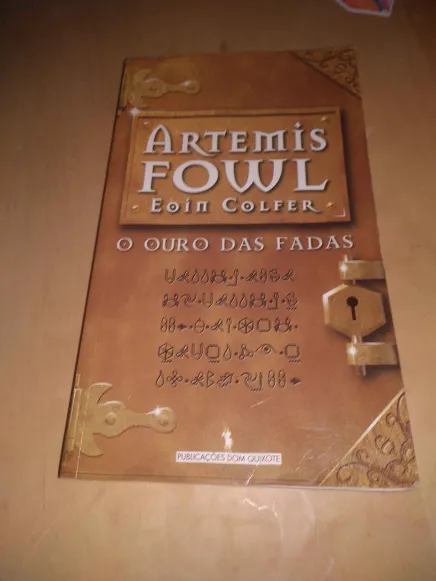
Photograph of the Portuguese Version of the first Artemis Fowl book Titled “Artemis.Fowl O ouro das Fadas” the front cover is visible.
Let me first set up the scene. You are 12, perhaps a bit younger but not much further from it. School tells you you’re gifted, a genius! Psychiatrists call it another thing, Asperger and your mother calls you yet another thing. A burden. You don’t have many friends. Not in the way that matters and the few you do you mostly bond over pieces of media that have come out and you judge. In 10 years or so you will find out they’re just as neurodivergent as you, not to mention queer. Yes, that egg will crack, but not yet. For now you’re 12, you’ve just fought with your mother and your brother over not presenting as you should and you are on the internet in one of your favorite websites. Reading is your only escape, and you are an avid user of your local library but right now you’re in your room and you know what’s expected of you. To not be seen, not after you raised everyone’s hackles. Luckily you found a website that has a lot of PDF versions of books that you will one day own as an adult. They’re in Brazilian Portuguese, some in English but you are particularly good at that language. In here you have found The Princess Diaries a series that will mean the world to you and help your EGG eventually crack. And in here you have more Meg Cabot books. She will eventually become your favorite author.
But at that moment you’re not attracted to Meg Cabot. You see that they have published a series of new books, it’s 2008 and your mind wonders. Artemis Fowl, you ask yourself. Who’s that?
Who is Artemis Fowl?
As I sit down between translation work, and hope to share more news of that soon I find myself thinking about the little girl that read Artemis Fowl at that time. It is a book series that means a lot to me, to the point I have written fanfic out of it and followed the sequel series and it is one that I in great part hold dear to my heart. The question of course is, what then is Artemis Fowl?
Created by Eoin Colfer who some may better known for writing the sixth installment of the Hitchhikers Guide to the Galaxy Artemis Fowl is about this boy genius of 12, smarter than anyone in the world and his interactions with a bunch of faeries. Taking from the author’s own experience and existence as an Irish person the book greatly bases itself on the old Irish Myths of the faeries imagining it instead as this more modern sci-fi like world. For instance the world for leprechaun? It becomes LEP (Lower Elements Police) Recon, or LEPrecon, which is basically their version of SWAT and specialised teams. In this universe the people have gone into hiding thousands of years ago, and Artemis Fowl the second, who is at an age where he is smart enough to be dangerous but young enough to still believe in magic decides to hold one of the elements of the faery world hostage so he can get their gold. Cue Holly Short…Yeah Artemis is quite the little monster in this book, with only a few moments that show that he is, in actuality, a scared child with a very sick mother and a missing father….
He gets better. Obviously. But you can see the appeal to someone who thought for the longest time that their biggest virtue and strength was how smart it was. It is a clichê for a reason, the gifted kid to flunking in university path but I never had to try or even study because the material was just so…clear to me, memorise and dump, basically. An isolated kid who cannot handle peers his own age, and is overly verbose but creeps people out because of the Little Professor thing? You can see the appeal to an autistic kid who was bullied for being “weird”.
So I ended up falling in love with the Artemis Fowl (the second) series. Enough to write fanfic for it, enough to make it a big part of my vocabulary, and learn the language in the series to encode my diaries just as I had earlier done with the Matoran Script from Bionicle.
Eventually I would find the Portuguese version of the book for sale for about 2 to 3 euro in an old flea market and I just knew that I had to get it. If not to re-read, something I do every 3 or 4 years, at least to honor that memory. And it’s in Artemis Fowl’s Portuguese translation, though sadly they only translated books 1 and 2 out of a 8 book series that I find what is perhaps one of the greatest ever localization choices. But we will get to it in due time. For after all, Artemis Fowl was, along with the Saga of Darren Shan one of my first great narrative loves and there is plenty to love about this book translation.
Meter o Rossio na Betesga
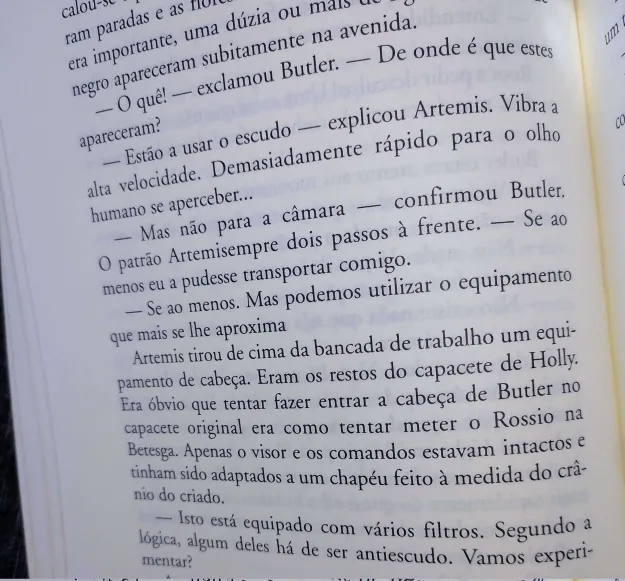
Portuguese text from Artemis Fowl
The text above reads as
“—O quê! — exclamou Butler — De onde é que estes apareceram?
— Estão a usar o escudo — explicou Artemis. Vibra a alta velocidade. Demasiadamente rápido para o olho humano se aperceber…
— Mas não para a câmara — confirmou Butler. O patrão Artemis sempre dois passos à frente. — Se ao menos eu a pudesse transportar comigo.
— Se ao menos. Mas podemos utilizar o equipamento que mais se lhe aproxima.
Artemis tirou de cima da bancada de trabalho um equipamento de cabeça. Eram os restos do capacete de Holly. Era óbvio que tentar entrar a cabeça de Butler no capacete original era como tentar meter o Rossio na Betesga. Apenas o visor e os comandos estavam intactos e tinham sido adaptados a um chapéu feito à medida do crânio do criado.
— Isto está equipado com vários filtros. Segundo a lógica, algum deles há de ser antiescudo. Vamos experimentar?”
Here is the context one needs to know. Artemis Fowl has managed to kidnap a LEPRecon officer and has stolen their technology. Now, LEP officers are tiny, clocking in at around one meter and one centimeter, so trying to fit those pieces of technology onto a full grown adult, let alone one who is described as towering and imposing is a tough task. Impossible even, ridiculous an ask. This is where we first encounter an example of a Portuguese localization that I can’t help but admire. The translator of this book, Maria Eduarda Colares, peppers the text with a lot of Portuguese sayings and expressions such that it is actually a delight to go through the book and find them all. In this case, Meter o Rossio na Betesga is a wonderful, wonderful Portuguese saying that won’t make sense to anyone who isn’t from Portugal, or I should say Lisbon.
To understand the saying all one has to do is to look at a map of Lisbon. I have gotten one from Open Street Maps do keep in mind that tiny little street highlighted in red at the bottom right corner is Betesga, while Rossio is the whole square above.
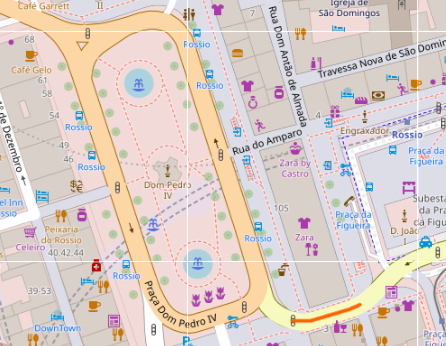
Screenshot showing Open Street Maps View of Rossio and Betesga, a very narrow street highlighted with red. To Put Rossio in Betesga then means to put something big in something small, an impossible task.
Betesga is one of the narrowest, smaller streets in Lisbon. It can be crossed in just a dozen steps. To Meter o Rossio Pela Betesga “To Put Rossio through Betesga” is therefore to do something impossible to fit something huge through something small. It is such a particularly Portuguese expression and yet it fits so much when you’re trying to put a tiny helmet meant for a smallish creature into a man towering over 2 meters tall!
But this is not the only quality localisation that the Artemis Fowl book has, for there are more…
To be “A Leste” of something
Here is the context, two people, doctors, very well renowned in their field are arguing with each other. They heavily disagree with one another. They are questioning each other’s authority and competence. In fact they’re refusing to work with one another. It is ugly, at least until they are forced to work together. During such a confrontation one says that the other is “miles from reality”. Now that would be easy enough to translate right? So far away from reality, he has no clue, so many options to translate, and I can only sadly wish I had my English version but I’m still in the Netherlands. There are so many options so what does the translator, who I have named earlier decide to use?
Well here is the excerpt.
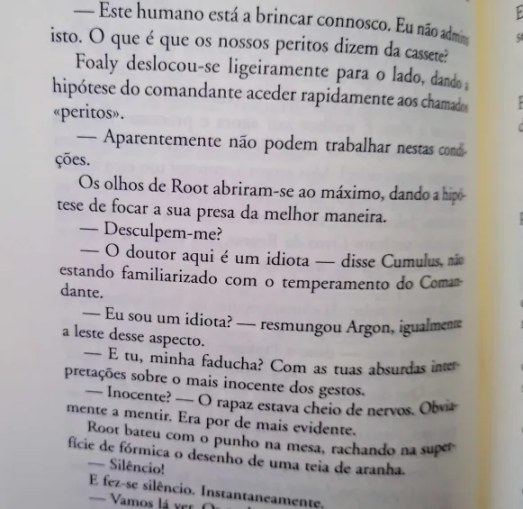
Photo of a page of text, in Portuguese, part of Artemis Fowl.
The page reads
“—Este humano está a brincar connosco. Eu não admito isso. O que é que os nossos peritos dizem da cassete?
Foaly deslocou-se ligeiramente para o lado, dando a hipótese do comandante aceder rapidamente aos chamados <peritos>.
—Aparentemente não podem trabalhar nestas condições.
Os olhos de Root abriram-se ao máximo, dando a hipótese de focar a sua presa da melhor maneira.
—Desculpem-me?
—O doutor aqui é um idiota — disse Cumulus não estando familiarizado com o temperamento do Comandante.
—Eu sou um idiota? — Resmungou Argon igualmente a Leste deste aspecto.
—E tu, minha faducha? Com as tuas absurdas interpretações sobre o mais inocente dos gestos.
—Inocente? O rapaz estava cheio de nervos. Obviamente a mentir. Era por de mais evidente.
Root bateu com o punho na mesa, rachando na superficide de fórmica o desenho de uma teia de aranha.
—Silêncio!
E fez-se silêncio. Instantaneamente.”
And now I’ve given you just a glimpse of the Portuguese translation I think it’s about time to talk about being “a Leste of something”. I won’t claim to know the historical origin of the expression. Whether it comes from a bit of rivalry with our Eastern neighbours in Spain or whether it has something to do with Orientalism but the truth is that “To be at East” of something is to be completely clueless, out of the loop. To not have a clue. A lesser translator would use “Que também não fazia ideia” “That also didn’t know” but once again the translator saw fit to introduce a Portuguese expression into the mix.
But the next one? The next one is the big one I am most excited for.
An Irish Eye – Um olho à Boavista?
Boavista is a football club that is …or was a regular in the Portuguese first division. They are the only club that has won a title besides the big 3 in the last 50 or so years, and they were a historical fixture before monetary issues meant the club has been dissolved and now pays in the Distritals of Porto. That is to say they went from winning the highest tier of Portuguese football to just…playing semi-professional football where the players are paid all of a ham sandwich and some juice to play.
It is a sad history and one that perhaps I will go into way more depth one of these days, but it is not why I’m here. Because the translator for this book decided to write that Artemis Fowl got “Um olho à Boavista”, a “Boavista like eye”. What does that mean?
Well I think it’s important, first of all to showcase what the equipment for Boavista is. Here is a picture from a random game I managed to find, not without some effort:

A player for Boavista (in 1992/1993) wearing the checkered pattern that got them the name “os axaderejados” (the chess like.
See Boavista regularly plays in a checkered black and white pattern that got them the name “Os Xadrezes” (the chesses). Because the black and white pattern is fairly distinct and comparable to a chess set. So when the author wanted to indicate that Artemis Fowl, who had unwisely provocked an Elf had a black eye after being hit? What did they get afterward? A black eye, on very white skin. In Portugal this can be called (coloquially, I mean), a “chess eye”. But what did the translator do? To the point it stuck in my mind for over 10 years after I read it for the first time? They called it a “Boavista Eye”.
There. Now there is a reference that NO ONE will get outside of Portugal. Now there’s that domestication of text. And me? I think it elevates this translation above the usual ones. It was such an inspired, great choice. It stuck with me.
In closing.
When I think back to that girl at 12, scared, alone, feeling like the world was against her and about to go through the worst challenge of her life in just a bit I cannot help but feel grief. There is so much about her, from the gender identity, to the trauma to come that I wish I could speak to her about, that I could warn her. Tell her to not dismiss Twilight as just “that stupid thing my classmates are into” because she will read it and unironically seeing a female perspective in Bella Swan will mean a lot to her. To the point that when she goes to the Pacific Northwest she goes to see Forks in what has to be a daily thing for locals. Tell her that she will be ok, that in the end we will get out of the dangers to come. And that though things don’t get any easier, that she at least will have friends and a network. That she will get to be loved, and above all free.
Artemis Fowl is very much tied to that point in my life. Not the worst moment of my life but all that loneliness, that anger, at myself, at the world, at not being like the other “kids”. That elitist superiority like I’m better than all the other kids because I don’t listen to Pop or watch morangos com açucar (it’s a portuguese thing). I guess if there is something I can appreciate is that it good a good translation. Somehow as a translator it reminds me that every book is someone’s favorite. Artemis Fowl may not be my favorite book, or half as relevant nowadays to my life as anything by Susan Bassnet but it still fills me with warmth when I revisit it. Especially when I do it when my life is tumultuous. The translator could have easily done a half-assed job. It’s a children’s book, it’s not like anyone would write in and complain and yet…yet I’m glad it’s got the translation it deserved. And though I work with videogames not books (for the most part) all I can say is that it’s an inspiration. What wonderful work was done in it.